
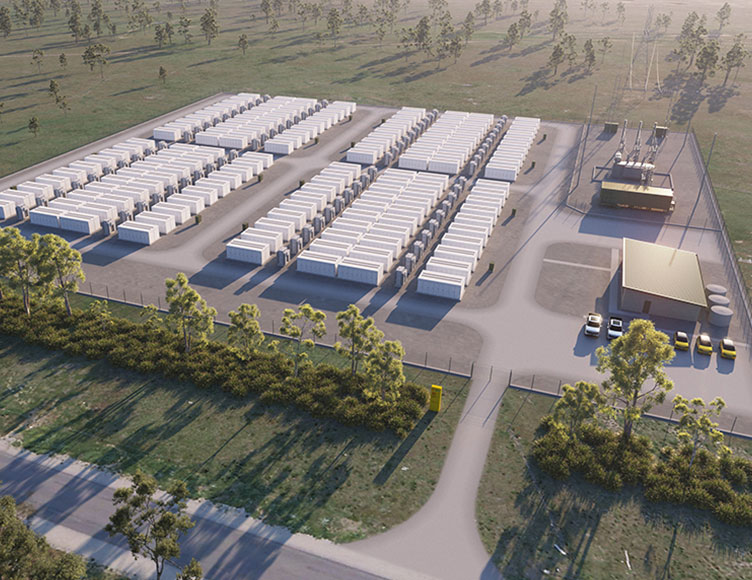
A Finnish renewable energy investor, Korkia, and a Chilean development partner, Solar Ray, recently secured environmental approval for a 150/750 MWh BESS project in Chile. The Paicavi BESS was authorized by the regional environmental permitting authority. The project is close to an existing substation and is designed to draw and store extra electricity into the substation and feed it back into the grid. Operation of the Paicavi BESS is expected to begin in September 2028 and reach end of life in November 2058. The partnership is also focusing on developing solar and storage and stand-alone BESS projects in Chile. This development also includes the construction of 150 containerized 5MWh battery units and a 33/110kV step-up substation to integrate with the national grid. It also combines 280 MW of utility-scale solar PV with a 1.24 GWh BESS. These developments depend on robust hardware such as cable suspension clamps.
Cable suspension clamps ensure the safety, reliability, and longevity of the electrical infrastructure. The cable clamps provide mechanical support for power cables, electrical protection, and grid integration. Suspension clamps provide mechanical support for power cables that interconnect battery storage units, inverters, and transformers. They support the weight of the conductors to prevent excessive sagging that could lead to short circuits. Suspension clamps absorb and dissipate vibrations caused by wind, seismic activity, and operational forces. Cable suspension clamps work with insulated bushings to ensure electrical isolation. They maintain a safe distance between conductive parts and structural components. This prevents accidental contact, ground faults, and flashovers.
Quality assurance for cable suspension clamps used in Chile’s BESS projects
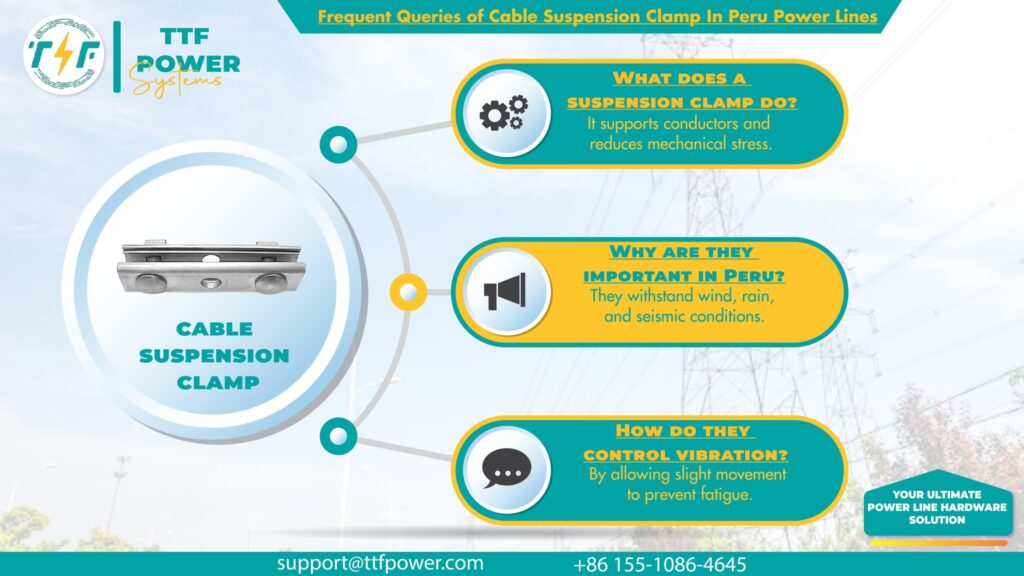
Cable suspension clamps secure and support heavy power cables to help manage thermal and mechanical loads. The quality assurance program for cable suspension clamps includes specification and design review, supplier qualification, inspection, testing, traceability, installation quality assurance, and maintenance protocols. Without quality assurance, suspension clamps may face material non-conformance, welding, corrosion failure, dimensional non-conformance, thread defects, and improper clamp selection. Quality assurance during installation includes correct clamp type per design, proper torque application on bolts, alignment checks, verification of cable seating, and documentation with photos. TTF-certified cable suspension clamps ensure mechanical integrity, operational reliability, and regulatory compliance for Chile’s high-value BESS infrastructure.
The key roles of cable suspension clamps in Chile’s BESS project installation
Cable suspension clamps ensure safe, reliable, and organized cabling in BESS facilities. They ensure the structural, operational, and safety performance of the BESS system. Here are the roles of the cable suspension clamps in Chile’s BESS project installation.
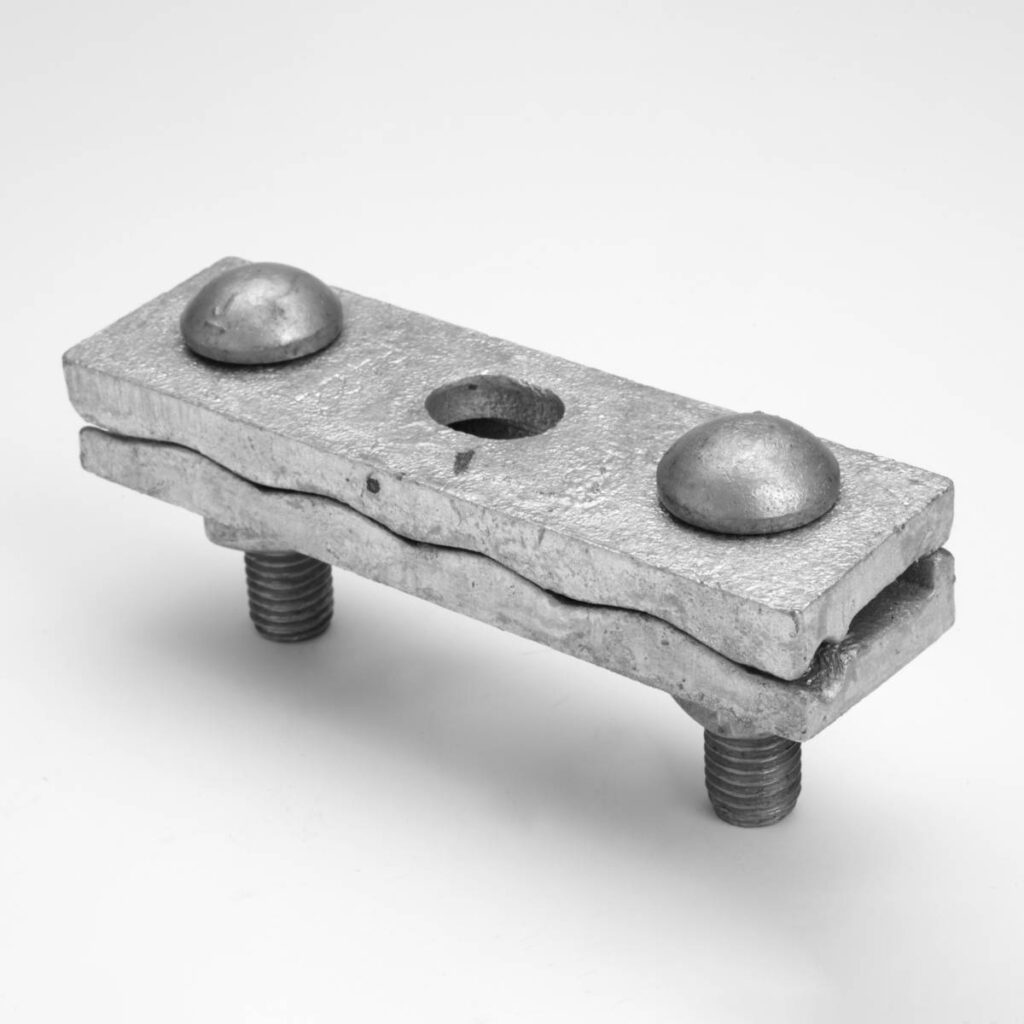
- Supporting cable weight—cable suspension clamps bear the weight of power, control, and communication cables. They prevent sagging, maintain alignment, and reduce stress on cable insulation and termination points.
- Maintaining proper alignment—the clamps ensure that cables remain routed along trays, racks, or overhead supports. They also ensure the cables remain spaced to avoid mechanical interference. They also ensure the cables remain at the necessary clearance from equipment, walls, or grounding structures.
- Reducing mechanical stress—suspension clamps help distribute mechanical loads and mitigate stresses caused by cable tension. The clamps reduce the risk of insulation damage, fatigue, and cable failure.
- Ensuring electrical safety—cable clamps hold cables to prevent unintended contact with grounded structures, reduce the risk of abrasion, insulation wear, and short circuits. They also maintain proper separation between high-voltage and low-voltage cables.
Market and system impacts of Chile’s BESS project development
The development of battery energy storage systems in Chile creates a transformative effect across energy markets and the operational power system. BESS enables higher renewable penetration, reduces curtailment, and mitigates volatility. These impacts include:
- Enhanced grid flexibility and renewable integration—BESS projects enable energy time-shifting by storing excess generation during low-demand periods. They reduce renewable curtailment and increase the economic value of PV and wind projects.
- Price volatility mitigation—large-scale storage mitigates short-term price spikes by injecting stored energy when spot market prices are high and absorbing excess generation when prices are negative.
- Improved grid reliability and resilience—BESS projects strengthen system reliability by providing dispatch to balance load and generation. They also maintain continuity during transmission congestion or line outages.
- Delay of transmission and distribution investment—BESS can reduce load on existing substations and reduce congestion costs. This results in economic and environmental benefits in regions with constrained grid infrastructure.